20 October, 2026
FemtoTGV for Laser Drilled Glass Semipermeable Membranes

Through-glass vias (TGV) are usually discussed in the context of semiconductor packaging. This paper – Blauvelt, D.G., Vainoris, M. Laser micro drilled glass semipermeable membranes for microfluidic blood oxygenators – however, analysis the same process only used for a different application.

Dr. David G. Blauvelt (Nemours Children’s Health) develops microfluidic blood oxygenators for ECMO, a life-support therapy for patients with severe respiratory failure. His membranes need a rigid support full of small, straight pores that oxygen can pass through.

Until now, he made these supports from silicon using deep reactive ion etching (DRIE), which is slow and expensive to scale.

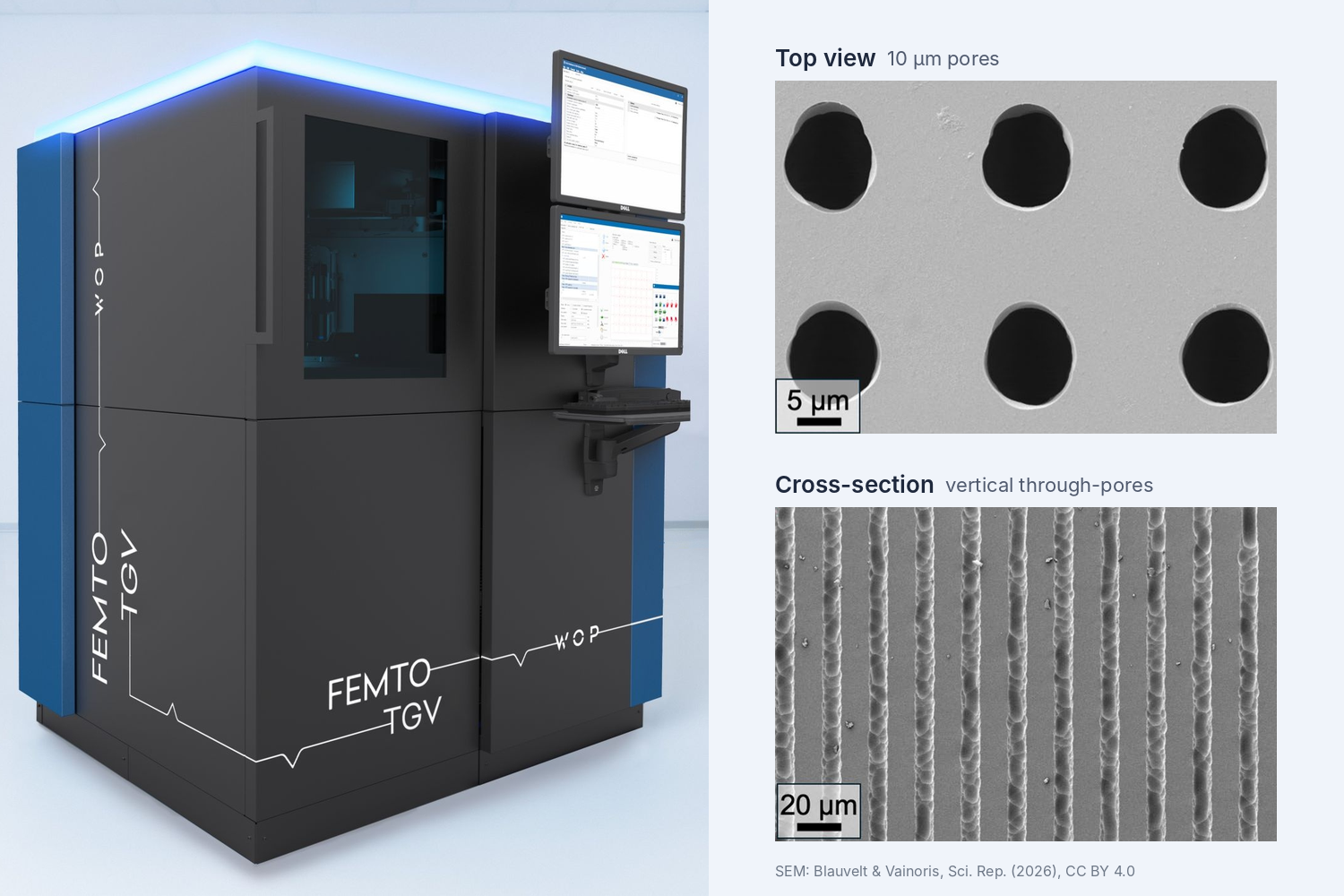
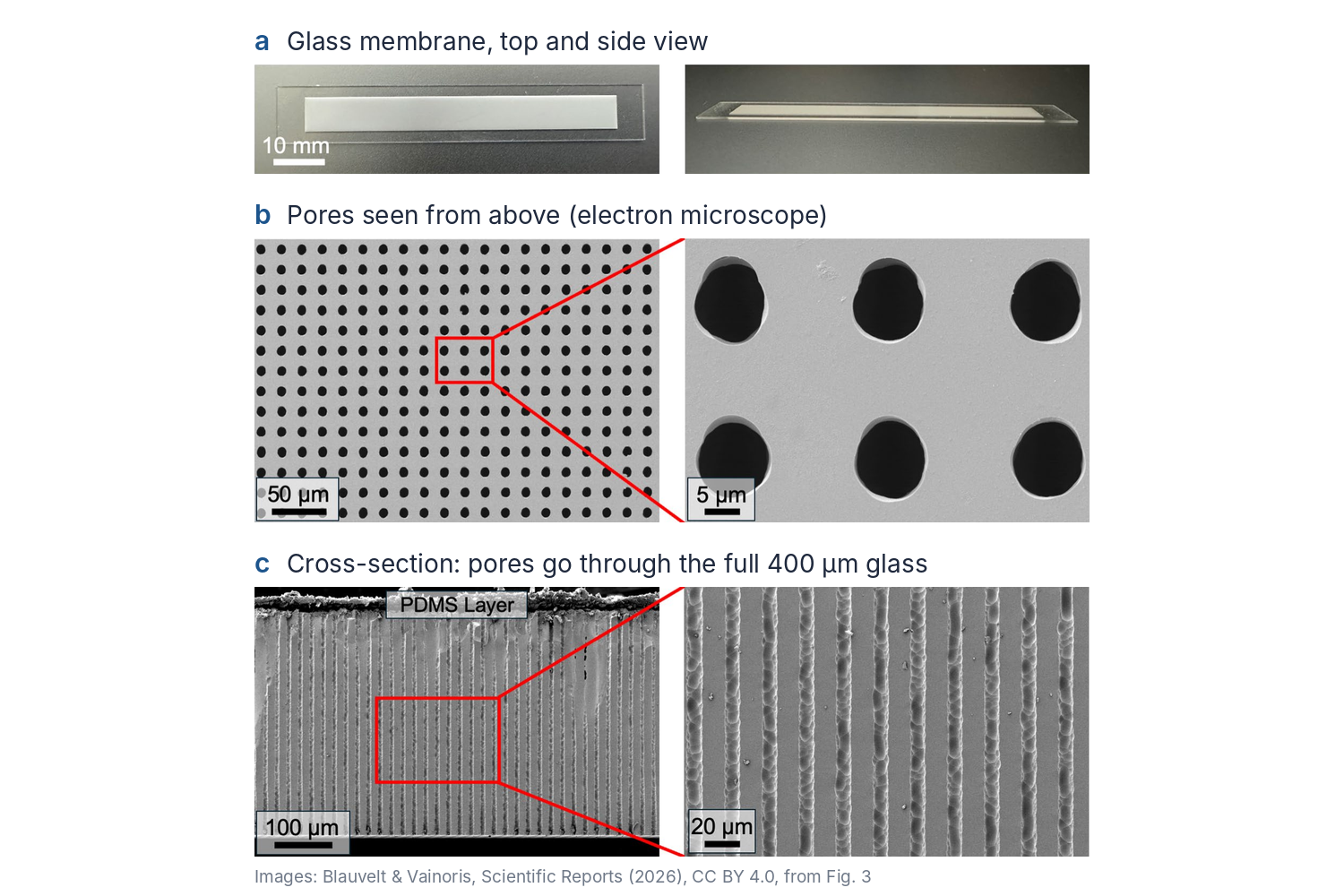
Together with Modestas Vainoris from our Workshop of Photonics | WOP team, he tested glass drilled on our FemtoTGV system instead: 400 µm borosilicate glass modified with a femtosecond Bessel-like beam, then KOH-etched, with a 5 µm PDMS layer bonded on top. In practice, the membrane is a dense TGV array: 825.000 through-holes per 10 × 65 mm piece.

The FemtoTGV system utilizes a CARBIDE Yb-based femtosecond 1030 nm laser source (Light Conversion, Vilnius, Lithuania) and a custombuilt optical engine setup, which produces as Bessel-like beam. The laser system is equipped with mechanical XYZ stages (Aerotech, Pittsburgh, USA) allowing sub-micron precision.

What was measured:

  • Pore diameter 10.29 ± 0.75 µm and pitch 20.03 ± 0.15 µm (targets: 10 and 20 µm)
  • Vertical through-pores across the full 400 µm thickness; no incomplete pores were found
  • Because the pores go all the way through, the whole membrane area is active (100% vs 72.7% in the silicon design)
  • Oxygen transfer of 0.59 ± 0.13 vol% vs 0.28 ± 0.09 vol% for the silicon membranes
  • Projected membrane cost for a neonatal oxygenator: about $8,500 vs about $103,000

These are benchtop results, and the costs are projections. Still, it is a good example of how a process developed with chip packaging in mind can be useful somewhere quite different.